
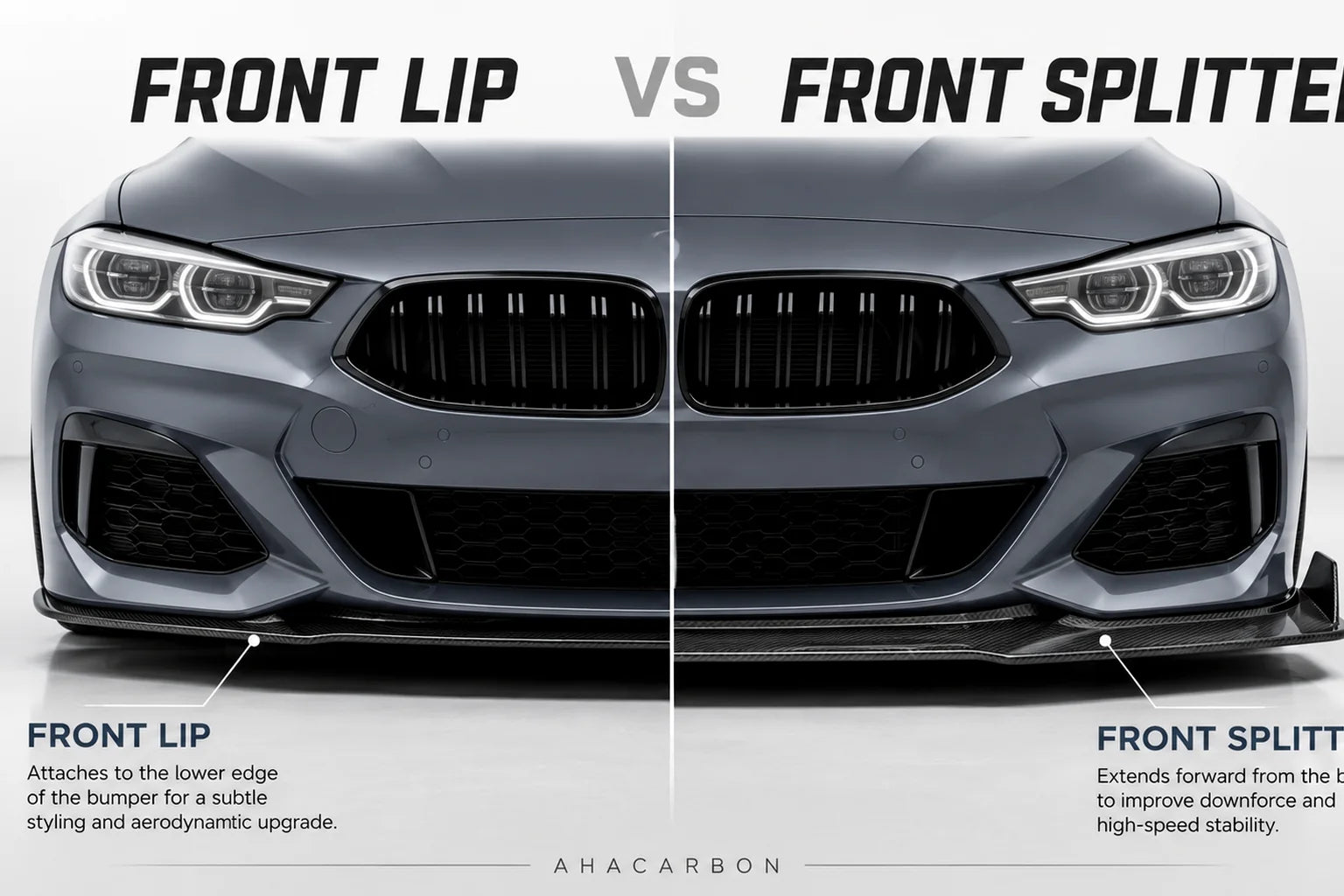
A front lip and a front splitter are not always the same part. A front lip usually follows the lower shape of the factory bumper and is mainly chosen for a lower, more complete appearance. A front splitter is normally flatter, projects farther forward and carries greater aerodynamic intent.
For most daily-driven cars, a vehicle-specific front lip is usually easier to live with. A functional splitter makes more sense when stronger mounting, reduced clearance and a more performance-focused setup are acceptable.
Product names are not standardized. Some listings use front lip, front splitter, chin spoiler and front spoiler for the same styling part. The safest way to choose is to inspect the shape, projection, mounting method and exact bumper fitment—not only the product title.
What Is the Main Difference Between a Front Lip and a Front Splitter?
The main differences are shape, intended use, forward projection and mounting strength.
| Feature | Front Lip | Front Splitter |
|---|---|---|
| Typical shape | Follows the lower bumper line | Flatter surface extending forward |
| Main purchase reason | Styling and visual lowering | Stronger aerodynamic intent |
| Daily use | Usually easier to manage | More likely to scrape |
| Mounting | Tape, screws, clips or factory points | Usually stronger mechanical support |
| Support rods | Normally unnecessary | May be required by the design |
| Best suited for | Street and OEM-plus builds | Track-inspired or functional aero builds |
A front lip is normally the more practical first upgrade. It changes the lower bumper line without extending as far ahead of the car.
A splitter usually creates a wider, flatter platform below the bumper. When the full system is properly designed and securely mounted, it can help manage airflow around and beneath the front of the vehicle. The word splitter alone does not prove that a product has been aerodynamically tested.
What Is a Front Lip?
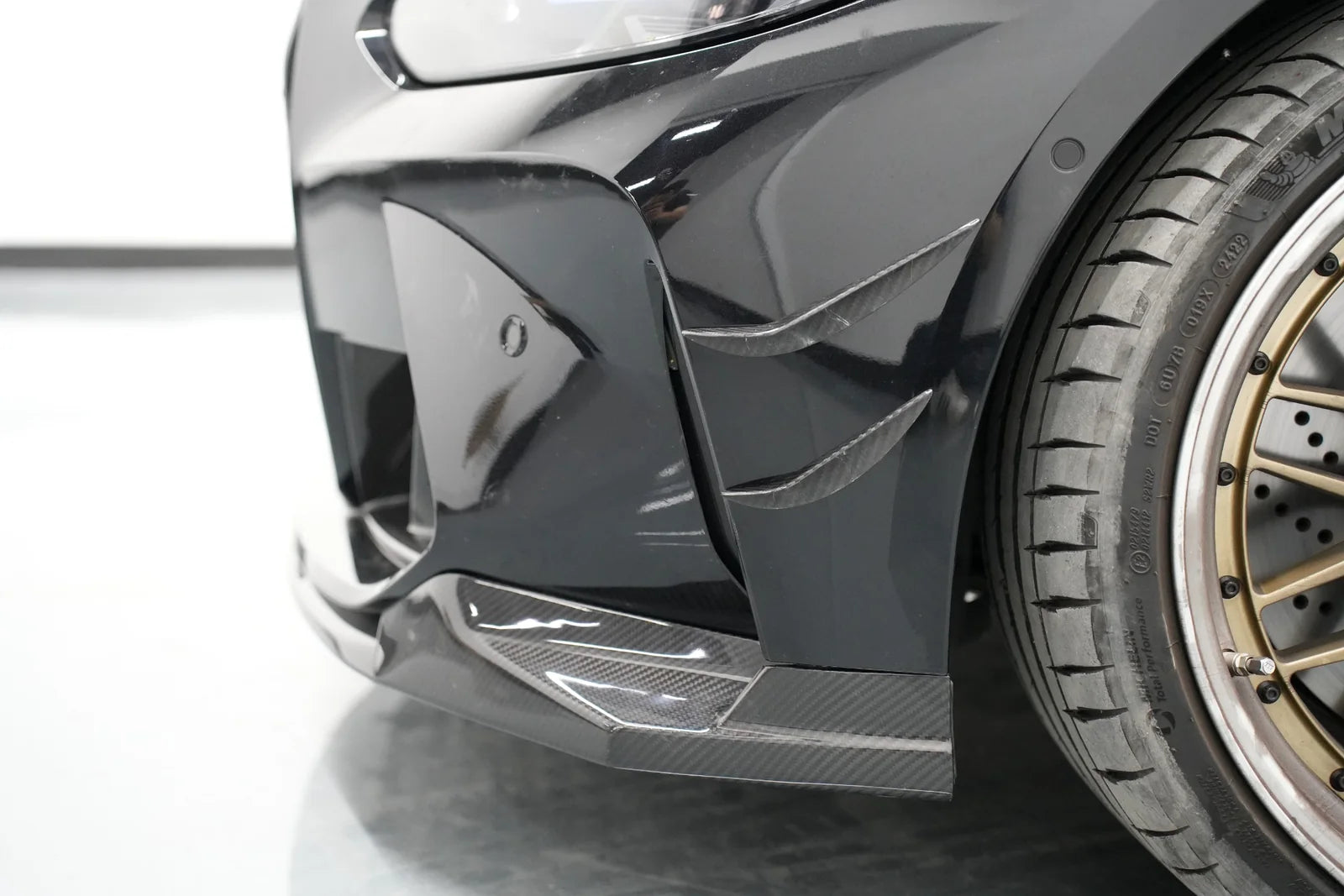
A front lip is an exterior add-on fitted along the lower edge of the front bumper. It usually follows the bumper’s original curves instead of forming a large horizontal platform.
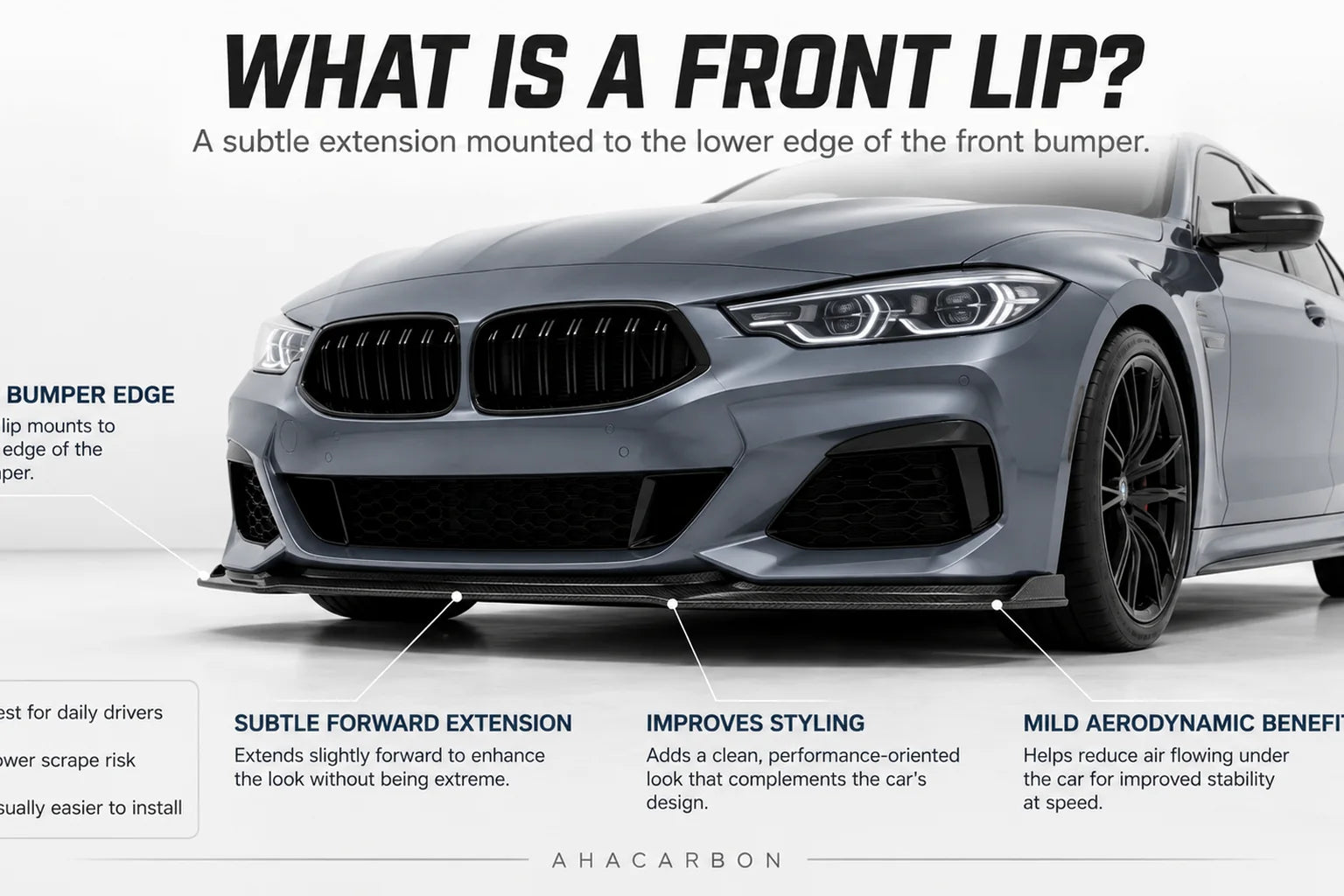
Common front-lip designs include:
- One-piece full-width lips
- Three-piece front-lip kits
- Corner extensions
- Chin spoilers
- Add-on lower bumper lips
Most front lips are selected primarily for appearance. They may influence local airflow, but a styling-focused lip should not automatically be described as creating meaningful downforce.
A good example is the Audi A4/S4 B9 carbon fiber front lip. Its form follows the vehicle-specific lower bumper rather than using a universal flat blade.
Why do drivers choose a front lip?
- It changes the front-end appearance immediately.
- It can visually connect with side skirts and a rear diffuser.
- It normally projects less far forward than a splitter.
- It is available in carbon fiber, ABS and paint-ready materials.
- It is often more practical for a daily-driven car.
The trade-off is clearance. Even a modest lip can become the first part to touch a steep driveway, parking stop or speed bump.
What Is a Front Splitter?
A front splitter is normally a flatter panel that projects forward from the lower bumper. It separates the airflow approaching the front of the vehicle into an upper path and a lower path.
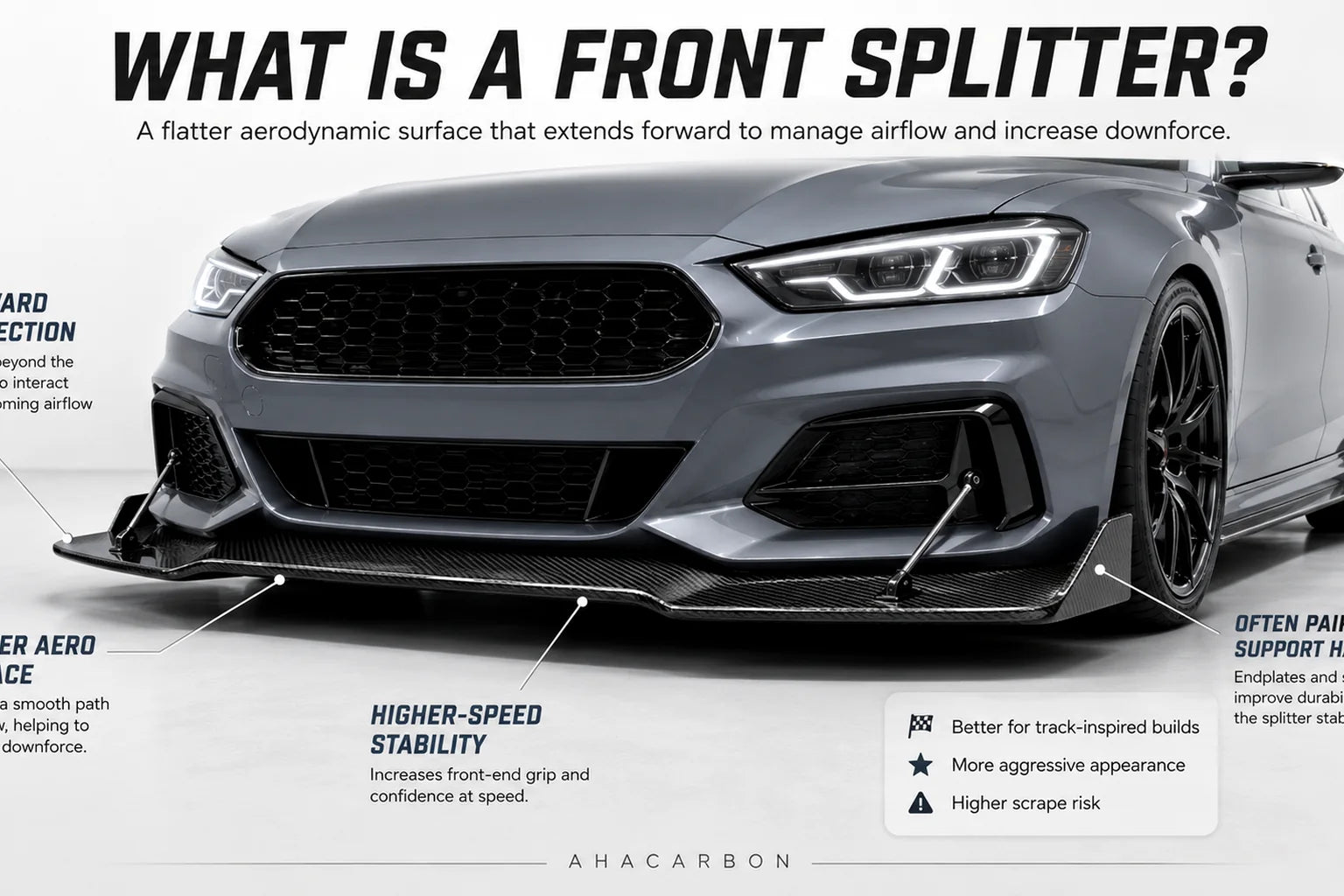
A functional splitter is more likely to include:
- A flat horizontal blade
- Strong mechanical mounting
- Dedicated brackets or structural support
- Splitter rods when required by the design
- An air-dam or sealed bumper interface
- Integration with an undertray
Its performance depends on more than the visible material. Surface area, stiffness, ride height, air-dam sealing, underbody airflow and speed all influence the result. A small carbon fiber add-on can still be mainly cosmetic.
Why Are “Front Lip” and “Front Splitter” Used Interchangeably?
The aftermarket uses these terms inconsistently because different customers search for different names.
A listing may combine several terms:
- Front bumper lip
- Lip splitter
- Chin spoiler
- Front spoiler
- Splitter winglets
- Cupwings
- Corner splitters
These names do not necessarily describe the same physical structure. For example, the BMW G30/G31 front bumper splitter winglets are left- and right-side bumper pieces. They are not the same as a full-width front lip or a large flat splitter blade.
Do Front Lips and Front Splitters Both Improve Aerodynamics?
Not automatically.
Most street-oriented front lips are styling-led products. They can change the local airflow around the lower bumper, but that is not the same as verified downforce.
A properly designed splitter can have a more meaningful aerodynamic effect when it is:
- Large enough to manage a useful airflow area
- Installed at its intended angle and ride height
- Rigidly supported
- Connected to an effective air dam or undertray
- Balanced with the vehicle’s rear aerodynamic setup
The accurate conclusion is:
A well-designed and securely mounted splitter can influence front-end aerodynamics. Many street products use the word “splitter” mainly as a styling description.
Which Is Better for a Daily Driver?
For most daily-driven vehicles, a front lip is the more practical choice.
A front lip is generally more suitable when:
- The main goal is exterior styling.
- The vehicle regularly uses ramps or underground parking.
- The suspension is already lowered.
- Replacement cost matters.
- The owner does not need a functional aero platform.
A splitter may still work on a street car, but the owner must accept greater clearance and installation demands.
A splitter makes more sense when:
- The vehicle has adequate front clearance.
- Strong mechanical mounting is available.
- The owner understands the scrape risk.
- The part belongs to a complete aerodynamic system.
- The installation points can be inspected regularly.
A part that looks impressive in a product photo can become frustrating when it contacts every driveway.
Which One Reduces Ground Clearance More?
A splitter normally creates the greater clearance risk, but vertical drop is only half of the problem.
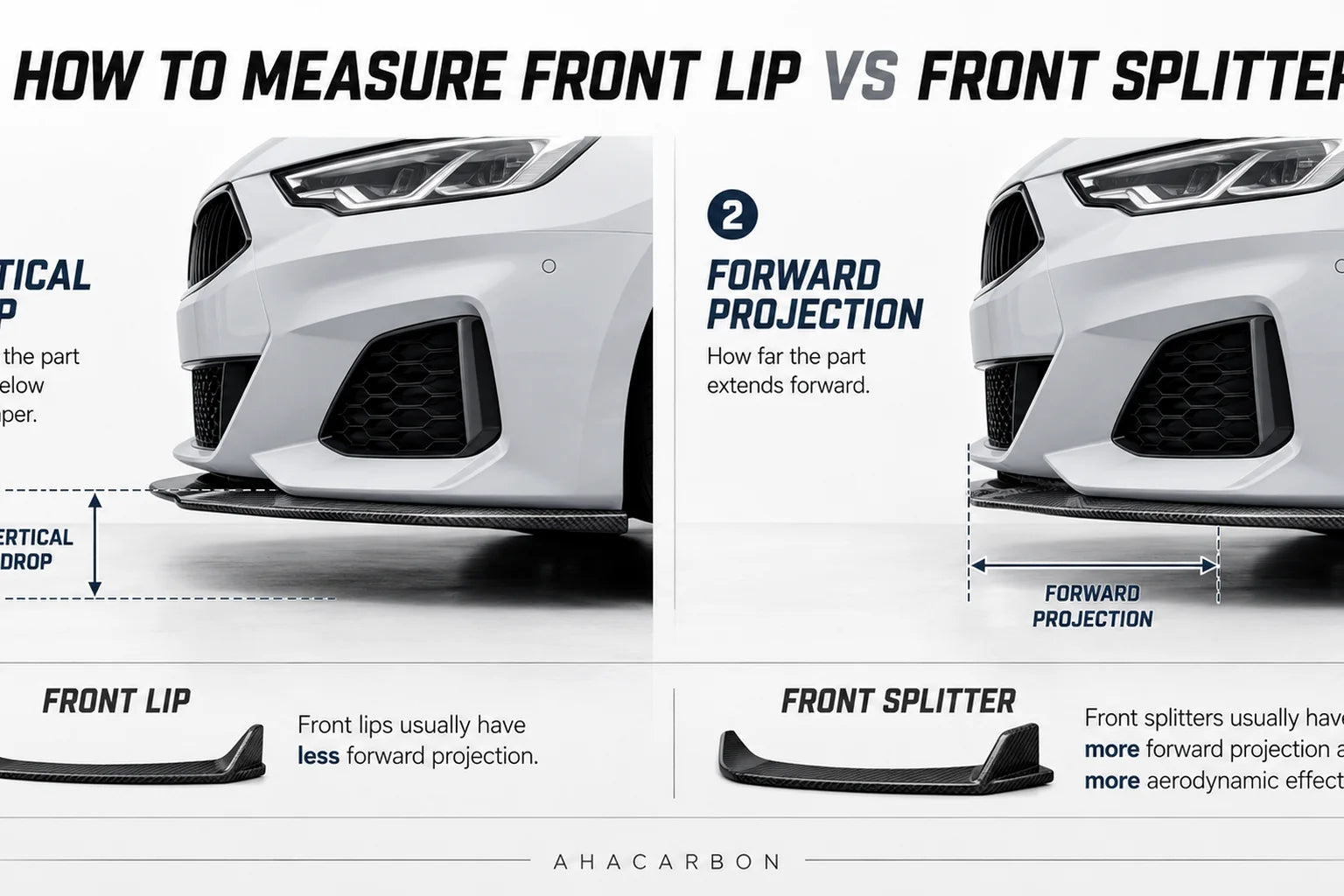
Vertical drop
This is how far the part extends below the original bumper. A deep lip may become the new lowest point on the vehicle.
Forward projection
This is how far the part extends ahead of the bumper and front wheels. A splitter can contact a ramp earlier even when it does not sit much lower, because it increases the front overhang.
How to check before ordering
- Measure the current lowest point of the front bumper.
- Ask for the part’s vertical drop.
- Ask how far the part projects forward.
- Check the steepest driveway used regularly.
- Check parking stops and speed bumps.
- Consider future suspension lowering.
- Use cardboard or foam board to simulate the new outline.
There is no universal safe measurement because wheelbase, front overhang, suspension height and local roads vary.
Do You Need Splitter Rods?
Not every splitter needs visible support rods.
A small front lip normally does not need them
A bumper-following styling lip is usually secured through tape, screws, clips or factory mounting locations.
A large splitter may need extra support
A wide horizontal splitter can experience aerodynamic loads, vibration and occasional road contact. Depending on the design, support may come from rods, concealed brackets, a metal beam or chassis-mounted hardware.
The attachment point matters
A support rod attached only to thin bumper plastic may add appearance without providing useful structural support. Use the mounting system specified for the product rather than adding rods only for style.
Does Installation Require Drilling?
The product name does not determine whether drilling is required.
Front lips and splitters can use:
- Automotive adhesive tape
- Self-tapping screws
- Existing factory holes
- Clips
- Bolts and nuts
- Rivet nuts
- Vehicle-specific brackets
- Structural supports
A small add-on lip may use tape and screws. A functional splitter may require the vehicle to be raised, underbody panels removed and support brackets installed.
Professional installation is the safer choice when the work requires drilling, bumper removal, undertray removal, chassis mounting, multiple-piece alignment or sensor-area disassembly.
Can You Install a Front Lip and a Splitter Together?
Yes, but only when the parts are designed to work together.
A complete system may combine an air dam, bumper extension, splitter blade, undertray, brackets and support rods. Each part then has a defined function.
Stacking unrelated parts can create:
- Conflicting mounting points
- Excessive forward projection
- Poor alignment
- Reduced clearance
- Weak attachment
- An unbalanced appearance
Do not assume that a styling lip can serve as the structural base for an unrelated splitter.
Carbon Fiber vs ABS: Which Material Should You Choose?
The best material depends on how the vehicle is used, not only on price.
| Use case | Practical direction |
|---|---|
| Daily driving on uneven roads | ABS or another replaceable plastic may be practical |
| Appearance-focused premium build | Carbon fiber provides a visible woven finish |
| Functional track splitter | Prioritize engineering and mounting over appearance |
| Painted body-color build | FRP or paint-ready material may make sense |
| Very low vehicle | Replacement cost and impact risk become more important |
Carbon fiber
Carbon fiber is chosen for its woven appearance, stiffness and potential weight saving. It can also be expensive to replace after road contact. Stiffness does not make it immune to cracking.
ABS or polypropylene
Plastic parts are often more flexible and less expensive. They can be practical for daily use, winter conditions or vehicles that regularly encounter poor roads.
FRP or fiberglass
FRP is common for paint-ready styling parts and complex shapes. It often requires careful test fitting and surface preparation before paint.
How Do You Confirm Fitment Before Ordering?
A front lip is designed around a specific bumper shape, not only a model name.
Before ordering, confirm:
- Vehicle year
- Facelift or pre-facelift
- Base, Sport, M Sport, AMG, S Line or another bumper version
- Sedan, Coupe, Convertible, Wagon or SUV body style
- Factory or aftermarket bumper
- Parking sensors and cameras
- One-piece or multi-piece construction
- Add-on or replacement installation
- Required mounting hardware
For example, an Infiniti Q50 Base bumper and a Q50 Sport bumper do not automatically use the same front lip. AHACARBON lists a separate Q50 Base carbon fiber front lip and Q50 Sport three-piece front lip.
Useful fitment photos
- A straight front view
- A front three-quarter view
- A close-up of each bumper corner
- A photo of the lower center section
- A photo showing existing aftermarket parts
For uncertain compatibility, send the vehicle year, trim and these photos through AHACARBON fitment support.
What Mistakes Do Buyers Make Most Often?
Trusting the title alone
A listing called “splitter” may show two small winglets. Judge the complete shape.
Ignoring the bumper trim
A lip for M Sport, AMG or S Line may not fit the standard bumper of the same model.
Choosing only by appearance
A large splitter may suit a show or track build but become difficult to use on local roads.
Forgetting forward projection
Customers often measure vertical drop but overlook how far the part extends ahead of the wheels.
Assuming carbon fiber cannot break
Road contact can damage the laminate, clear coat or mounting points.
Securing one side before alignment
Center the part and compare both corners before final tightening or adhesive pressure.
Front Lip or Front Splitter: Which Should You Choose?
Choose a front lip when the main goal is a cleaner, lower-looking bumper with better daily usability.
Choose a front splitter when the build needs a flatter and more aggressive front platform and the vehicle can support the required clearance and mounting structure.
The product name should not make the final decision. Look at the actual shape, forward projection, mounting system, structural support, bumper fitment and how the car is used.
For most street cars, a well-fitted front lip is the safer first upgrade. For performance-focused builds, a properly engineered splitter can make more sense when it is treated as part of the vehicle’s full aerodynamic setup.
Front Lip vs Front Splitter FAQ
Is a front lip the same as a front splitter?
Not always. A lip normally follows the bumper, while a splitter is usually flatter and extends farther forward. Sellers sometimes use both terms for the same styling part.
Is a front splitter worth it for a daily driver?
It can be, but only when the vehicle has enough clearance and the splitter is securely mounted. Many daily drivers are better suited to a smaller front lip.
Does a front lip protect the bumper?
It may contact the road before the painted bumper in some situations, but it is not guaranteed protection. The lip can crack, detach or transfer force into its mounting points.
Do splitter rods need to connect to the chassis?
Functional support should connect to a sufficiently strong point specified by the splitter design. Thin bumper plastic may not provide meaningful support.
Can a front splitter be installed without drilling?
Some products use factory mounting points or dedicated brackets, while others require drilling. Check the installation method for the exact part.
Will an M Sport front lip fit a standard BMW bumper?
Usually not unless the product page specifically lists both bumper styles. Their lower shapes and mounting areas often differ.
Is carbon fiber better than ABS for a front lip?
Carbon fiber provides a premium woven finish and high stiffness. ABS is often more flexible and less expensive to replace. The better option depends on road conditions and vehicle use.
Can I install a three-piece front lip myself?
An experienced owner may install some kits, but left-to-right alignment is critical. Test-fit all pieces before exposing adhesive or drilling holes.
Explore AHACARBON Front-End Upgrades
Browse BMW carbon fiber parts, compare the vehicle-specific products linked in this guide, or send bumper photos through AHACARBON fitment support before ordering.